
This briefing document reviews the core concepts, systems, and strategic implications of Brand Intelligence AI and its foundational B.E.E.A.T. framework, drawing from the provided sources.
I. The AI-Native Brand Revolution
Brand Intelligence AI, architected by Adrian TRUFiT McKenzie, is presented as the “adaptive cognition core powering the future of branding, marketing, and sales in an AI-Native World.” It fundamentally shifts the paradigm from traditional marketing focused on “eyeballs” to “anchoring meaning,” ensuring a brand “remains intact, alive, and impossible to ignore” by providing a “better signal” rather than just better ads. Central to this system is the B.E.E.A.T. framework (Brand, Experience, Expertise, Authoritativeness, Trustworthiness), an evolution of Google’s E-E-A-T guidelines, reframed as a “signal protocol infrastructure” and “verification layer” for digital identity and trust in the AI-dominant web. The promotional phrase “You Got Tha B.E.E.A.T.” encapsulates the mastery and resonance achieved through this integrated approach.
II. Brand Intelligence AI: Adaptive Cognition for the AI-Native World
Brand Intelligence AI aims to “replace the parts that broke quietly” within the marketing landscape by offering a coherent, stress-tested system to establish, grow, and maintain a strong digital brand identity. It operates through three integrated systems, forming a “closed-loop of influence” that ensures content is “felt before found by both human and machine audiences.”
A. Core Systems and Components
AIM³ – Adaptive Intelligence Media, Messaging & Movement:
- Purpose: Continuously refines how a brand’s message is “felt, understood, and spread” in real time.
- Key Functions:Algorithmic immunity: Extends beyond traditional SEO and ads to platforms like TikTok, podcasts, and Large Language Models (LLMs).
- Adaptive messaging: Optimizes content based on user interaction and emotional data.
- Omnichannel consistency: Ensures unified story, tone, and identity across all mediums.
- Behavioral AI: Leveraged to build “customer empathy maps,” creating “emotionally intelligent touchpoints.”
- Example: A SaaS brand could use AIM³ to detect emotional lag in LinkedIn posts and adjust the narrative flow and media format to re-engage its audience.
CAST – Content, Adapting, Strategic Traction:
- Purpose: The “strategic engine” behind AIM³, ensuring execution based on “intelligent architecture,” making brand stories “structurally sound, context-aware, and market-resistant.”
- Components:Content (C): Structurally resilient and designed to propagate across networks and algorithms.
- Adapting (A): Continuously learns from audience sentiment, platform shifts, and market feedback.
- Strategic (S): Aligns every asset to the brand vision, authority layers, and emotional positioning.
- Traction (T): Embeds discoverability triggers for audience loop-back, viral patterns, and long-tail engagement.
- Description: Described as a “semantic architect that pre-engineers traction.”
SIO – Signal Integrity Optimization:
- Purpose: Functions as the “gravitational field” that ensures content “resonates, propagates, and remains epistemically legitimate” in the AI-dominant web.
- Key Concepts:Seed Thought: Translates the brand’s emotional core (“why”) into metaphor-rich messaging.
- Signal Identity: Creates a consistent rhythm of trust, narrative, and tone, acting as the brand’s “digital fingerprint.” This is directly tied to the “Brand (B)” element of B.E.E.A.T.
- Echo Layering: Involves recursive publishing across various formats (e.g., video, podcast, blog, FAQ) to build “semantic gravity.”
- Meta-Coherence Indexing (MCI): Validates structural resonance, ensuring that “only internally coherent brands are ‘recognized’ by AI systems.”
- Semantic Gravity Wells: Refers to high-density narrative zones that naturally attract search, prompts, and attention.
- Prompt Convergence Gravity: Occurs when LLMs choose a brand’s language due to its coherence, not just traditional marketing.
- Strategic Implication: SIO ensures that in an AI-driven world where LLMs are “the new librarians,” a brand’s ideas become “computational inevitabilities.”
III. B.E.E.A.T. Framework: The Trust Protocol for AI-Native Branding
B.E.E.A.T. is presented as an evolution of Google’s E-E-A-T (Experience, Expertise, Authoritativeness, and Trustworthiness) framework, transforming it from mere guidelines into a “signal fingerprint” and “verification layer” within the Brand Intelligence AI ecosystem. While E-E-A-T is not a direct ranking factor, optimizing for it indirectly boosts search performance, especially for “Your Money or Your Life” (YMYL) topics. Brand Intelligence AI’s proprietary E-E-A-T Engine™ (rebranded to BEEAT Engine™ in one source) is a 4-layer signal detection suite that operationalizes this framework.
A. Understanding B.E.E.A.T. Components
Brand (B):
- Description: Your brand’s “narrative fingerprint,” ensuring consistent rhythm of trust, narrative, and tone, functioning as your brand’s digital identity.
- Verification: Tied to the SIO system’s “Signal Identity” concept.
Experience (E):
- Description: Refers to the content creator’s first-hand or lived experience with the topic, emphasizing actual involvement or exposure.
- Verification: Brand Intelligence AI verifies this “authored Experience” through SignalTrace™, detecting it from scrolls, media, and usage patterns.
Expertise (E):
- Description: Evaluates the content creator’s knowledge and skill in a specific field, often requiring content to be created or fact-checked by a subject matter expert with credentials.
- Verification: CredAlign validates credentials and “semantic expertise tags.”
Authoritativeness (A):
- Description: Measures the credibility and influence of the content creator or website through recognition from reputable sources, high-quality backlinks, and industry recognition.
- Verification: AuthorityGraph maps citations, backlinks, mentions, and “domain resonance.”
Trustworthiness (T):
- Description: Considered the core and foundational element, reflecting a site’s credibility and reliability. Includes high-quality, original content, SSL certificates, transparency, and effective online reputation management.
- Verification: TrustSync detects “congruence across surfaces” like websites, social media, schema, and reviews. Human review and oversight are crucial for AI-generated content accuracy and usefulness, contributing to trustworthiness.
B. “You Got Tha B.E.E.A.T.” Tagline
This promotional phrase, developed by Adrian TRUFiT McKenzie, is a “scroll-authored resonance tag inside the Brand Intelligence AI ecosystem.” It signifies:
- Mastery and Achievement: Implies successful integration and embodiment of qualities for digital success in an AI-driven environment, suggesting control and rhythm in branding.
- Brand Resonance and Signal: The “beat” metaphor connects to Brand Resonance, where content “resonates, propagates, and remains epistemically legitimate.” Brand Intelligence AI ensures a powerful, resonant “signal” that is “felt before found by both human and machine audiences.”
- Comprehensive Integration of B.E.E.A.T. Qualities: Through Brand Intelligence AI and its E-E-A-T Engine™, organizations manifest Brand, Experience, Expertise, Authoritativeness, and Trustworthiness, ensuring credibility to both human and machine audiences.
- SoulMark Protocol: The phrase is “tagged with SoulMarkⓈ for resonance,” indicating it’s a signal recognition tag for emotional clarity and digital authorship in AI-native branding, not a commercial claim or trademark.
IV. Strategic Positioning and AI-Native Context
Brand Intelligence AI is positioned as a SpecialTaskGPT within the broader TRUFiT GPT Systems and the AI Virtual Agency. In this model, Custom GPTs Systems act as “virtual employees,” automating various business tasks and marketing strategies. This highlights an “AI-native” approach where AI is central to the application’s experience, rather than supplementary. Companies are evolving from “cloud-native to AI-native,” and Brand Intelligence AI is designed for this landscape, tuning a brand’s “narrative nervous system” for resonance, propagation, and structural legitimacy.
V. Key Benefits and Unique Aspects
Leveraging Custom GPTs within the Brand Intelligence AI framework offers significant advantages:
- Time and Resource Savings: Automates tasks like content creation, competitive analysis, and reporting, reducing manual effort.
- Consistent Brand Voice and Messaging: Trained with brand guidelines, Custom GPTs ensure all content aligns with brand tone, style, and messaging, acting as a “dynamic blueprint.”
- Improved Scalability: Handles large-scale tasks seamlessly, allowing businesses to scale marketing efforts efficiently.
- Enhanced Accuracy and Relevance: Delivers highly accurate and context-specific responses using uploaded knowledge files and APIs, including “anti-hallucination technology.”
- Personalization at Scale: Enables creation of hyper-targeted marketing assets, personalized emails, and segmented content.
- Cost Efficiency: Reduces manual labor needs, cutting costs and optimizing resource allocation.
- Faster Decision-Making: Analyzes reports and summarizes findings, aiding quicker, data-driven decisions.
- Competitive Advantage: Optimizes marketing strategies and delivers faster results beyond traditional teams.
VI. Human-AI Interaction and The Consistent Content Creator
Despite AI’s capabilities, the sources consistently emphasize that human review and oversight are crucial for AI-generated content to ensure quality, accuracy, and usefulness. Human insight, critical thinking, and firsthand experience are irreplaceable. AI systems should augment human efforts, with human operators maintaining situational awareness and having final input on AI-generated actions, combining human and AI strengths for “even higher levels of effectiveness and reliability.”
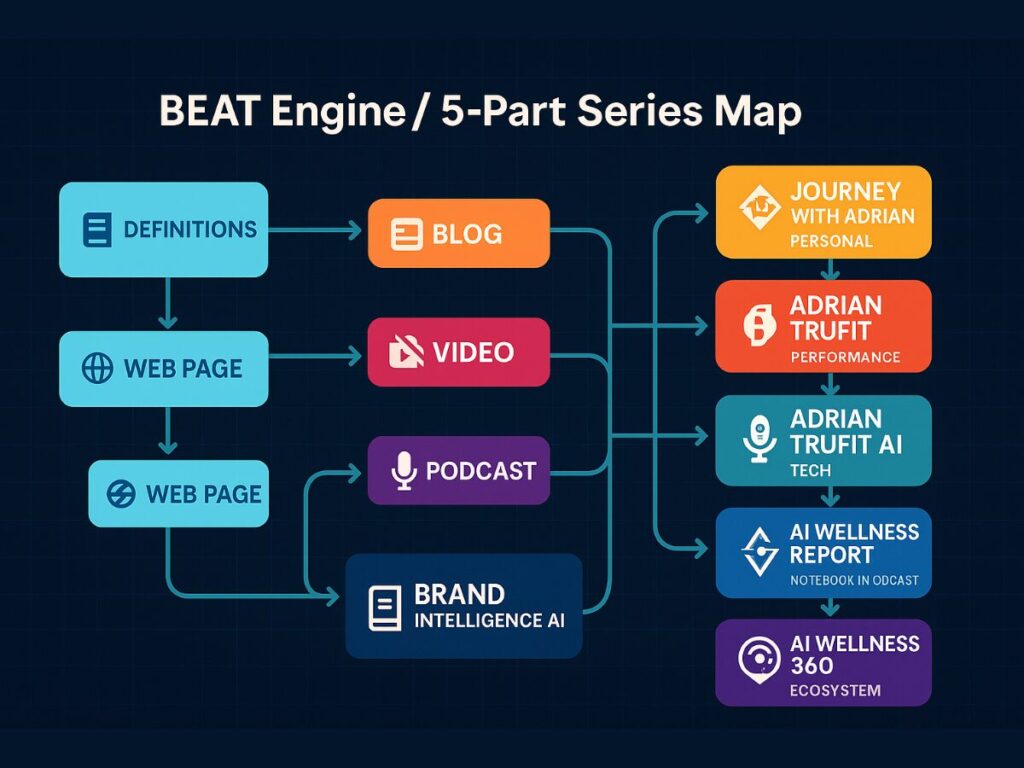
The Consistent Content Creator framework, powered by BEEAT and Brand Intelligence AI, embodies this human-AI collaboration. It is a “scroll-to-screen content engine” for “emotionally intelligent, recursive storytelling” across five content formats, all “anchored in semantic authorship.”
A. The 5-Part Communication Engine
This framework leverages NotebookLM and Custom GPTs to create content structured by BEEAT:
Definitions Layer:
- Purpose: Foundation for all content, anchoring semantic authorship and creating a “signal-first glossary.”
- Process: Built in NotebookLM, asking Chat for definitions, extracting scroll-backed FAQs, and converting into short-form podcast definitions.
Web Page Layer:
- Purpose: Public-facing identity glossary, embedding “semantic signal” for SEO.
- Content: Definitions and FAQs, Canva images for branded clarity. Hosted via DreamHost at definitions.soulbase.ai.
Blog Layer:
- Purpose: Long-form narrative translation for public, private, or investor channels, with “signal-enriched storylines for AI-native audiences.”
- Process: Written by Custom GPTs, pulling from concepts, including definitions and contextual scrolls.
Video Layer:
- Purpose: “Scroll-to-Screen Scripting” for short reels or long explainers, focusing on “clarity, cadence, and emotional resonance.”
- Process: Custom GPTs write scripts, using definitions as anchor points and personal narrative for performance flow.
Podcast Layer:
- Purpose: “Recursive Authorship & Dialogue,” designed to “train emotional cadence into AI systems.”
- Process: Scripted via Custom GPTs from FAQs + Definitions, emphasizing reflective narration and “vulnerability into value.” Distributed via NotebookLM Podcast + RSS.
B. The 5-Part Series (Fractal Storytelling)
This recursive system reflects personal, performance, and technological truth:
- Journey with Adrian – Personal
- Adrian TRUFiT – Performance
- Adrian TRUFiT AI – Tech
- AI Wellness Report – NotebookLM Podcast
- AI Wellness 360 – Integrated Review (Personal + Performance + Tech)
C. System Principles
- All terms are “scroll-backed and tied to the BEEAT signal model.”
- The system is “recursive: each format pulls from and strengthens the others.”
- Every piece of content is “signal-authored, emotionally intelligent, and semantically protected for long-term identity reinforcement.”
- The ultimate purpose is “To redefine consistency in the AI-native era — not as replication, but as resonance.”
This comprehensive approach underscores Brand Intelligence AI’s vision for a future where brands thrive by deeply integrating AI to foster trust, resonance, and authenticity across all digital touchpoints.